definitions
Mental models
def: fundamental concepts and representations about how the world works
→ what to think = principles, concepts
Thinking tools
def: practical methods that can be applied to solve problems
→ how to think = processes, frameworks
Metacognition
def:
- capacity to reflect on, evaluate and control cognitive processes such as decision-making, memory and perception.1
- capacity to use knowledge of a task at hand, knowledge of learning strategies and knowledge of oneself to plan learning, monitor progress towards learning goal and then evaluate the outcome.2
- process involved when learner plan, monitor, evaluate and make changes to their own learning behaviours.3
- meta = about the thing itself
- cognition = thinking process
- metacognition = thinking about one’s thinking process
Two dimensions:
- Metacognitive knowledge: learner’s knowledge of their own cognitive abilities (e.g. not good at remembering dates), the nature of particular tasks and different learning strategies including when to use them.
- Metacognitive regulation: how learners monitor and control their cognitive processes.
Metacognitive frameworks
def: structures for thinking about how you think — planning, monitoring and evaluating your own cognitive processes
→ they help learn and problem-solve more effectively by making thinking visible and deliberate
The core metacognitive cycle:
Plan → Monitor → Evaluate
- Plan: “what’s my goal? what strategy will i use?”
- Monitor: “am i understanding this? should i adjust?”
- Evaluate: “how did i do? what would i change next time?”
The classic metacognitive model:
→ “Flavell’s model”
There are three components you regulate:
- Metacognitive knowledge: what you know about your own cognition capabilities
- Metacognitive experiences: how do you feel during thinking
- Metacognitive strategies: what actions you take to control thinking (e.g. self-quizzing, re-reading, etc.)
categories
some broad categories about “what kind of thinking?”:
- Metacognition: Thinking about thinking
- Analysis and Structuring: Breaking down problems
- Systems and Complexity: Understanding interconnections
- Decision and Prioritisation: Making choices
- Risk and Uncertainty: Managing unknowns
- Creativity and Ideation: Generating ideas
- Communication and Alignment: Sharing understanding
and more in detail:
- Metacognition: the “director” tools
- → goal: monitor and improve your own thinking process
- Awareness tools:
- Ladder of Inference (tracing assumptions)
- ⭐ Circle of Competence (knowing boundaries)
- The Map is not the Territory (reality vs. model)
- Process Control tools:
- Six Thinking Hats (parallel thinking modes)
- Thought Experiment (testing ideas mentally)
- Jootsing (jumping out of systems)
- Reflection tools:
- ⭐ Second-Level Thinking (thinking ahead)
- ⭐ Inversion (thinking backward)
- Analysis and Structuring: the “architect” tools
- → goal: break down and organise information
- Decomposition tools:
- Issue Trees (MECE breakdown)
- Ishikawa Diagram (root cause analysis)
- ⭐ First Principles Thinking (breaking to fundamentals)
- Visual Organization:
- Concept Map (hierarchical relationships)
- Abstraction Laddering (moving up/down detail levels)
- Logic tools:
- ⭐ Occam’s Razor (simplicity principle)
- Multiplying by Zero (eliminating deal-breakers)
- Systems and Complexity: the “ecologist” tools
- → goal: understand interconnected systems
- System Dynamics:
- ⭐ Systems Thinking (holistic perspective)
- ⭐ Feedback Loop (reinforcing/balancing)
- Equilibrium (system stability)
- Butterfly Effect (sensitive dependence)
- Sense-Making tools:
- Cynefin Framework (problem domain classification)
- Iceberg Model (events → patterns → structures → mental models)
- Connection Circles (causal relationships)
- Scale & Emergence:
- Critical Mass (tipping points)
- Hierarchical Organization
- Surface Area (for interactions)
- Decision and Prioritisation: “the commander” tools
- → goal: make choices and allocate resources
- Value-Based tools:
- ⭐ Opportunity Costs (trade-offs)
- Comparative Advantage (specialisation)
- Global vs Local Maxima (optimisation)
- Prioritisation tools:
- Eisenhower Matrix (urgent/important)
- Parkinson’s Law (work expands)
- Incentive Structures:
- Incentives (motivation drivers)
- Supply and Demand (market forces)
- Arbitrage (exploiting differences)
- Risk and Uncertainty: the “navigator” tools
- → goal: manage unknowns and probabilities
- Risk Assessment:
- NASA Risk Matrix (likelihood/impact)
- Uncertainty Matrix (known/unknown quadrants)
- Diversification (spreading risk)
- Probabilistic Thinking:
- ⭐ Probabilistic Thinking (thinking in likelihoods)
- Regression to the Mean (statistical tendency)
- Efficient-Market Hypothesis (price information)
- Psychological tools:
- Fear Setting (proactive worry management)
- Hyperbolic Discounting (present bias awareness)
- Attentional Bias (focus effects)
- Creativity and Ideation: the “inventor“ tools
- → goal: generate novel ideas and solutions
- Idea Generation:
- Systematic Inventive Thinking (SIT templates)
- Thought Experiment (mental prototyping)
- Growth & Scale Concepts:
- Compounding Effect (exponential growth)
- Leverage (small input → large output)
- Economies of Scale (cost advantages)
- Velocity (speed matters)
- Energy Concepts:
- Activation Energy (getting started)
- Energy Preservation (conserving effort)
- Communication and Alignment: the “anthropologist” tools
- → goal: understand people and groups
- Behavioral Insights:
- Commitment and Consistency (social psychology)
- Hanlon’s Razor (don’t attribute to malice)
- Self-Preservation (fundamental drive)
- Strategic Principles:
- Irreducibility (minimum viable complexity)
- Second-Level Thinking (anticipating others)
list en vrac (>50+)
Abstraction Laddering
Activation Energy
Arbitrage
Attentional Bias
Butterfly Effect
Circle of Competence
Commitment and Consistency
Comparative Advantage
Compounding Effect
Concept Map
Connection Circles
Critical Mass
Cynefin Framework
Diversification
Economies of Scale
Efficient-Market Hypothesis
Eisenhower Matrix
def: decision-making tool which consists in a four-quadrant grid that can be used to prioritise tasks along 2 axes: urgency and importance.
- Important and urgent
- Important, but not urgent
- Urgent but not important
- Not urgent and not important
Which leads to these corresponding actions
- Do it immediately
- Decide, schedule a time to do it
- Delegate, assign to someone else
- Delete, get rid of the task
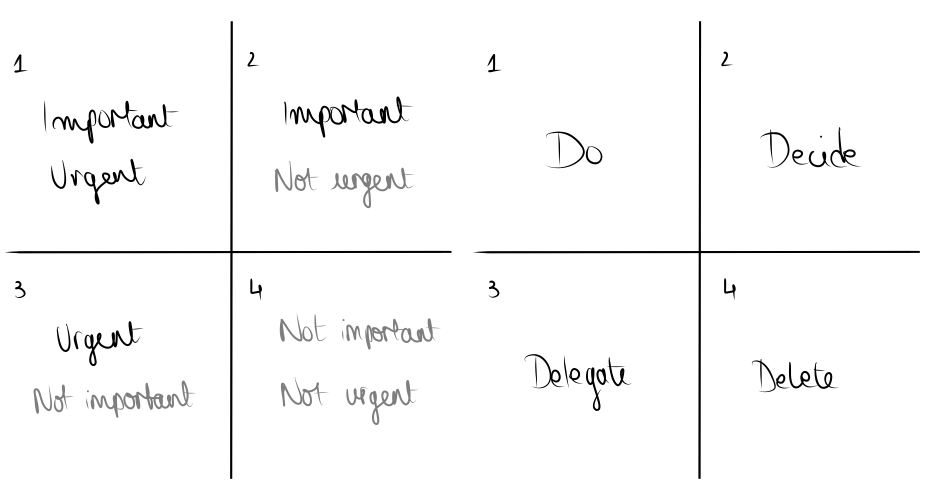 eisenhower matrix quadrants
Benefits:
- + simplify and streamline to-do list
- + improve productivity and focus on what matters more first
Energy Preservation
Equilibrium
Fear Setting
Feedback Loop
First Principles Thinking
def: practice of breaking down complex problems into their most basic components, then reasoning up from there
→ understand the basic principles behind something, get to the root of things first (basic individual parts)
- analogy: to bake a cake, you need to start with the basic ingredients, then you can start experiment w/ combinations, proportions, recipes
- core: “what is fundamentally true?” first, then build
Three main steps:
- break down problem into its individual parts
- understand how each part works
- experiment with different combinations, parameters to find a solution
Global vs Local Maxima
Hanlon’s Razor
Hierarchical Organization
Hyperbolic Discounting
Iceberg Model
Incentives
Inversion
Irreducibility
Ishikawa Diagram
Issue Trees
Jootsing
Ladder of Inference
Leverage
Multiplying by Zero
NASA Risk Matrix
Occam’s Razor
Opportunity Costs
Parkinson’s Law
Probabilistic Thinking
Regression to the Mean
Second-Level Thinking
def: thinking beyond the immediate, first-order consequences of a decision to consider the subsequent, longer-term and often unintended effects
→ immediate results <<< what could happen down the road?
- analogy:
- 1st level “watering the plants → it’ll grow”
- vs. > level “watering the plants → possibly lead to overwatering → roots will rot → attract fungus”
- core: “and then what?” again and again
- remark: beware of your biases and assumptions
The main steps:
- Stop and think: when faced with a decision, stop and think,
- what are the short-term (10min) vs. long-term (10years) consequences of each option?
- what are the risks vs. rewards?
- who are the stakeholders?
- … and then what?
- Consider all potential options: weigh pros vs. cons (csqs, risks, rewards)
- Make a decision
- Evaluate decision: after making the decision, take a moment to evaluate
- did you make the best decision possible?
- are you happy with the results?
- if not, why not? any unexpected consequences?
Self-Preservation
Six Thinking Hats
Supply and Demand
Surface Area
Systematic Inventive Thinking
Systems Thinking
The Map is not the Territory
Thought Experiment
Thought Experiment
Uncertainty Matrix
Velocity
deprecated
General Thinking Tools
- The Map is not the Territory
- Circle of Competence
- First principles thinking
- Thought experiment
- Second-order thinking
- Probabilistic thinking
- Inversion
- Occam’s Razor
- Systems thinking
- …
Critical Thinking Frameworks
- SWOT: Strength, Weaknesses, Opportunities, Threats
- Decision trees
- Mind mapping
Activation Energy
Arbitrage
Attentional Bias
Butterfly Effect
Circle of Competence
Commitment and Cons…
Comparative Advantage
Compounding Effect
Critical Mass
Diversification
Economies of Scale
Efficient-Market Hyp…
Energy Preservation
Equilibrium
Feedback Loop
First Principles Thinking
Global and Local Maxima
Hanlon’s Razor
Hierarchical Organization
Hyperbolic Discounting
Incentives
Inversion
Irreducibility
Jootsing
Leverage
Multiplying by Zero
Occam’s Razor
Opportunity Costs
Parkinson’s Law
Probabilistic Thinking
Regression to the Mean
Second-Level Thinking
Self-Preservation
Supply and Demand
Surface Area
The Map is not the Ter…
Thought Experiment
Velocity
sources:
- https://fs.blog/mental-models/
- https://jamesclear.com/mental-models
- https://nesslabs.com/mental-models
- https://toolbox.nesslabs.com/index